

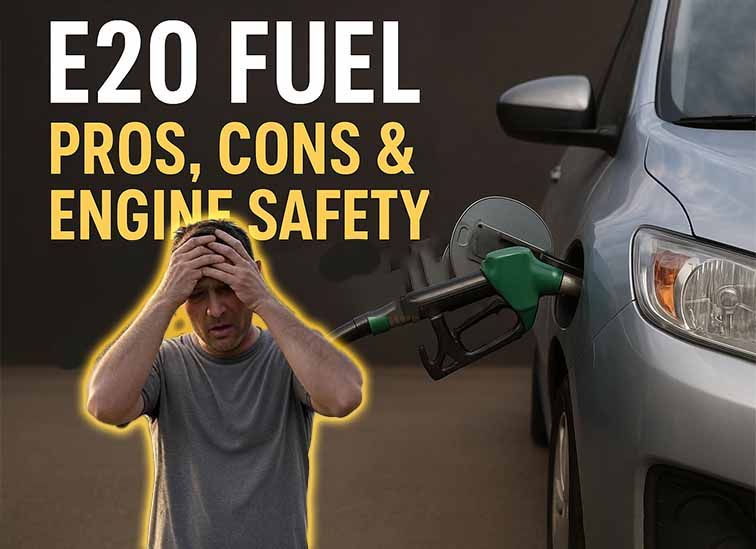

India’s roads are going through a transformation, not just with electric vehicles grabbing attention, but also with the government’s strong push for cleaner fuel alternatives. One of the biggest changes in this direction is the introduction of E20 fuel—a blend of 20% ethanol and 80% petrol.
At first glance, it sounds like a perfect step toward sustainability: less dependence on imported oil, reduced emissions, and an additional revenue stream for farmers. But if you own a vehicle today, you’ve probably wondered—will E20 fuel damage my engine? That’s the question millions of Indian motorists are now asking as petrol pumps begin dispensing this new blend.

In this article, let’s explore what E20 really is, how it can affect your engine, and the pros and cons of making the switch.
What Exactly is E20 Fuel?
E20 fuel is a mix of 20% ethanol (ethyl alcohol) and 80% petrol. Ethanol is not a new concept—it’s been used in countries like Brazil and the US for decades as a renewable fuel alternative. It is typically produced from sugarcane, corn, or agricultural residue, making it a biofuel that reduces dependency on crude oil imports.
The Indian government has ambitious plans for E20. By 2025, it aims to make E20 widely available across the country as part of the Ethanol Blended Petrol (EBP) Program. On paper, this promises cleaner air, stronger rural economies, and more stable fuel prices.
But, as with most things in the automotive world, what’s good for the environment doesn’t always work smoothly inside your engine.
Also read: Top 5 bike maintenance tips for Monsoon in 2024
Why E20 Can Damage Engines
While E20 is being hailed as a sustainable option, many experts and manufacturers warn that not all engines are built to handle it. Here’s why:
1. Corrosion and Wear
Ethanol is hygroscopic, meaning it absorbs water from the atmosphere. This moisture can lead to corrosion of fuel tanks, pipes, and injectors. Older vehicles, which were never designed with ethanol-resistant materials, are especially vulnerable. Rubber seals, gaskets, and metal components may degrade faster.
2. Lower Energy Content
Ethanol has less energy per litre than petrol. This means that when you run your car on E20, you may notice a drop in mileage. For vehicles not tuned for ethanol blends, the engine compensates by burning more fuel, which reduces efficiency.
3. Compatibility Issues in Older Cars
Many cars sold before BS6 Phase-II (April 2023) were designed with E10 (10% ethanol) compatibility in mind. Running them on E20 can lead to rough idling, engine knocking, and reduced lifespan of critical parts.
4. Phase Separation Problems
Since ethanol absorbs water, over time, it can separate from petrol inside the fuel tank—especially if the vehicle is not used for days. This “phase separation” can cause poor combustion, starting trouble, and even damage to fuel pumps.
5. Higher Maintenance Costs
With long-term use, E20 may increase wear and tear in engines not specifically built for it, leading to higher servicing bills and part replacements.
Also read: [2025] New GST Impact on Cars and Bikes Explained
Pros of E20 Fuel
Despite these drawbacks, E20 fuel does bring some undeniable benefits—both for the country and for the environment.
1. Cleaner Air
Ethanol burns cleaner than petrol, producing fewer greenhouse gases and particulate emissions. This directly helps reduce urban smog and air pollution.
2. Boosts Farmers’ Income
Since ethanol is made from crops like sugarcane and corn, farmers gain a new revenue stream, strengthening rural economies.
3. Reduced Oil Imports
India spends billions of dollars on crude oil imports. By producing ethanol domestically, the country can achieve greater energy independence.
4. Stable Pricing
Petrol prices often fluctuate due to global oil market volatility. Ethanol, being locally produced, helps stabilize fuel prices.
5. Higher Octane Rating
Ethanol has a higher octane number than petrol. This can help reduce engine knocking and allows for better performance in engines designed to run on ethanol blends.
Also read: Top 5 best cars under 5 lakh in India
Cons of E20 Fuel
On the flip side, here are the key challenges with E20 adoption:
1. Mileage Drop
Because ethanol contains less energy, most vehicles will see a slight dip in fuel efficiency—sometimes up to 6–8%.
2. Not Universally Compatible
Vehicles manufactured before 2023 may not be fully compatible with E20, leading to engine issues and durability concerns.
3. Corrosion Risks
Ethanol’s water-absorbing nature can lead to rust, clogged injectors, and early wear of fuel system components.
4. Infrastructure Costs
Widespread adoption of E20 requires new storage tanks, pipelines, and pumps at petrol stations, which involves heavy investment.
5. Agricultural Pressure
While ethanol supports farmers, large-scale ethanol production may lead to over-farming, deforestation, and excessive water usage, which raises new environmental concerns.
How to Know if Your Car Can Use E20
If you’re unsure about whether your vehicle can safely run on E20, here are a few steps you can take:
- Check your car manual – Newer models clearly state ethanol compatibility.
- Look at the fuel lid – Many modern cars have stickers like “E20” or “E10” printed near the fuel cap.
- Visit manufacturer websites – Brands like Maruti Suzuki, Hyundai, and Honda have released official lists of E20-compatible models.
- Ask a mechanic – A trusted service professional can guide you if your car needs any modifications.
If your car isn’t compatible, it’s best to avoid filling up with E20, at least until manufacturers release updated models optimized for this blend.
Also read: Top 12 Fastest cars in the world 2023 – 330+ mph cars
The Future of E20 in India

E20 is part of India’s long-term strategy to cut down fossil fuel use and promote greener alternatives. By 2025, fuel stations across the country will supply E20 as standard. Auto manufacturers are already updating their engines to be E20-ready, with BS6-II compliant cars designed for ethanol blends.
However, the transition won’t be smooth. Millions of older cars and two-wheelers on Indian roads may face engine troubles if owners unknowingly use E20. Public awareness campaigns, proper labeling at pumps, and gradual rollout will be key to minimizing disruption.
Final Thoughts
E20 fuel is a double-edged sword. On one side, it promises cleaner air, reduced oil imports, and a boost for Indian farmers. On the other, it poses a real risk of engine damage for vehicles not designed to handle it.
If you own a brand-new BS6-II car, E20 may actually enhance performance while lowering emissions. But for older cars, it could mean reduced mileage, corrosion, and higher maintenance costs.
The takeaway? E20 is good for the nation, but not always good for every car. Until the vehicle fleet in India becomes fully E20-ready, motorists must be cautious about what they’re filling in their tanks.
The green revolution in fuels has begun—but like every transition, it will come with growing pains.